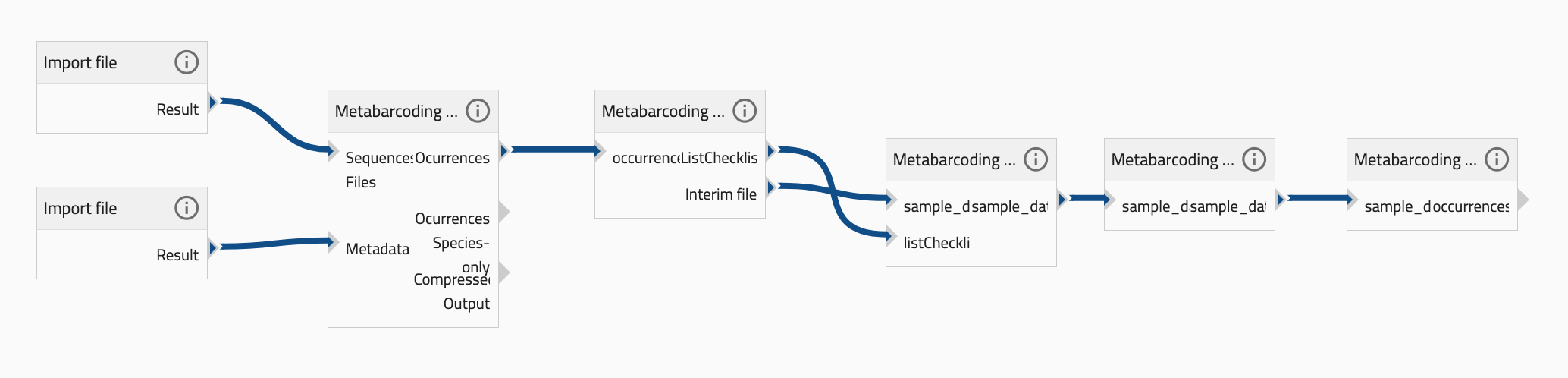
Metabarcoding Workflow - Detection of Non-native Invasive Species with metabarcoding - v2
Background
Freshwater ecosystems have been profoundly affected by habitat loss, degradation, and overexploitation, leaving them now especially vulnerable to biological invasions. Whether non-indigenous species are the key drivers or mere complementary factors of biodiversity loss is still debated among the scientific community, however biological invasions together with other anthropogenic stressors are determining population declines and homogenisation of biodiversity in freshwater ecosystems worldwide. For example, it has been demonstrated that river basins with greater numbers of non-indigenous species have higher extinction rates of native fish species. Consequently, the application of effective biomonitoring approaches to support protection actions of managers, stakeholders and policy-makers is nowadays essential.
Introduction
Conventional methods of monitoring freshwater fish diversity are based on direct observation of organisms and are therefore costly, labour and resource intensive, require taxonomic expertise, and can be invasive. Obtaining information about species and communities by retrieving DNA from environmental samples has the ability to overcome some of these difficulties. The molecular investigation of environmental samples is known as environmental DNA (eDNA). Environmental DNA can be isolated from water, soil, air or faeces as organisms shed their genetic material in the surroundings through metabolic waste, damaged tissues, sloughed skin cells and decomposition. The analysis of eDNA consists of extracting the genetic material and subjecting it to a Polymerase Chain Reaction (PCR) which amplifies the target DNA. The use of high-throughput sequencing (HTS) allows the simultaneous identification of many species within a certain taxonomic group. This community-wide approach is known as eDNA metabarcoding and involves the use of broad-range primers during PCR that amplify a set of species. In recent years, the cost of this technology has drastically decreased, making it very attractive in conservation management and scientific research. A number of studies have demonstrated that eDNA metabarcoding is more sensitive than conventional biomonitoring methods for freshwater fish as it can detect rare or low-abundance taxa. As a result, eDNA metabarcoding can be used as an early-warning tool to detect new NIS at the initial stages of colonisation, when they are not yet abundant in the ecosystem.
Aims
This validation case regards eDNA metabarcoding fish sequences collected from the Douro Basin in Portugal. DNA sequences are processed through a bioinformatic pipeline wrapped in the first part of the analytical workflow which conducts a quality check and assigns the DNA sequences to produce a list of taxa. The analytical workflow developed can process DNA sequences of different kinds, depending on the genetic markers used for the analysis and so this workflow can be applied to different taxonomic groups and ecosystems. The taxa identified might include indigenous organisms as well as newly identified taxa within a certain geographical region. For that reason, the national checklists of introduced and invasive species (GRISS) from GBIF are consulted to check if the organisms detected are recognised as NIS or if previously unrecorded NIS have been detected through eDNA metabarcoding analysis.<div><br></div><div>NOTE: this is the version 2 of the original workflow available at: <a href=" https://metadatacatalogue.lifewatch.eu/srv/eng/catalog.search#/metadata/b9367bcb-7d72-43db-896f-e2c372533001" target="_blank"> https://metadatacatalogue.lifewatch.eu/srv/eng/catalog.search#/metadata/b9367bcb-7d72-43db-896f-e2c372533001</a>.</div>
Default
- Date ( Publication)
- 2021-03-18
- Date ( Creation)
- 2019-07-04
- Status
- Completed
- Keywords
-
Metabarcoding
- Keywords
-
IJI
- Access constraints
- License
- Use limitation
-
GPLv3
- OnLine resource
-
Info page
(
WWW:LINK-1.0-http--link
)
- OnLine resource
-
Run the workflow
(
WWW:LINK-1.0-http--link
)
- Service Name
-
Metabarcoding Runner
- Service Description
-
A service that aims at computing a list of taxa IDs detected from metabarcoding sequences of environmental DNA (eDNA) samples. This service contains eight substeps implemented as a unique step.
- Service Reference (id)
- Service Name
-
Metabarcoding GBIF NIS Verifier
- Service Description
-
A service that aims at checking which taxa detected and identified from eDNA metabarcoding sequences are listed as NIS and which taxa are not (i.e. native or unrecorded NIS).
- Service Reference (id)
- Service Name
-
Metabarcoding GBIF Extractor
- Service Description
-
A service that aims at extracting from GBIF (Global Biodiversity Information Facility) taxa occurrence records that were not classified as NIS in Step 3 (GBIF NIS Verifier) of the Metabarcoding workflow. <br>
- Service Reference (id)
- Service Name
-
Metabarcoding Occurrence Intersector
- Service Description
-
A service that aims at intersecting the map(s) (geographical spatial polygons) from GBIF occurrence(s) with the locations of a list of taxa detected from eDNA metabarcoding and which were not included in the NIS checklist to verify if such eDNA detection(s) is/are likely to be new NIS detected in that location from eDNA sequences.
- Service Reference (id)
- Service Name
-
Metabarcoding RData To CSV
- Service Description
-
This service aims at converting the CSV into rdata.
metadataMetadata
- File identifier
- 67885733-f393-4a55-bdaa-999d0f3f83a0 XML
- Metadata language
- en
- Hierarchy level
- Workflow
- Metadata Schema Version
-
1.0