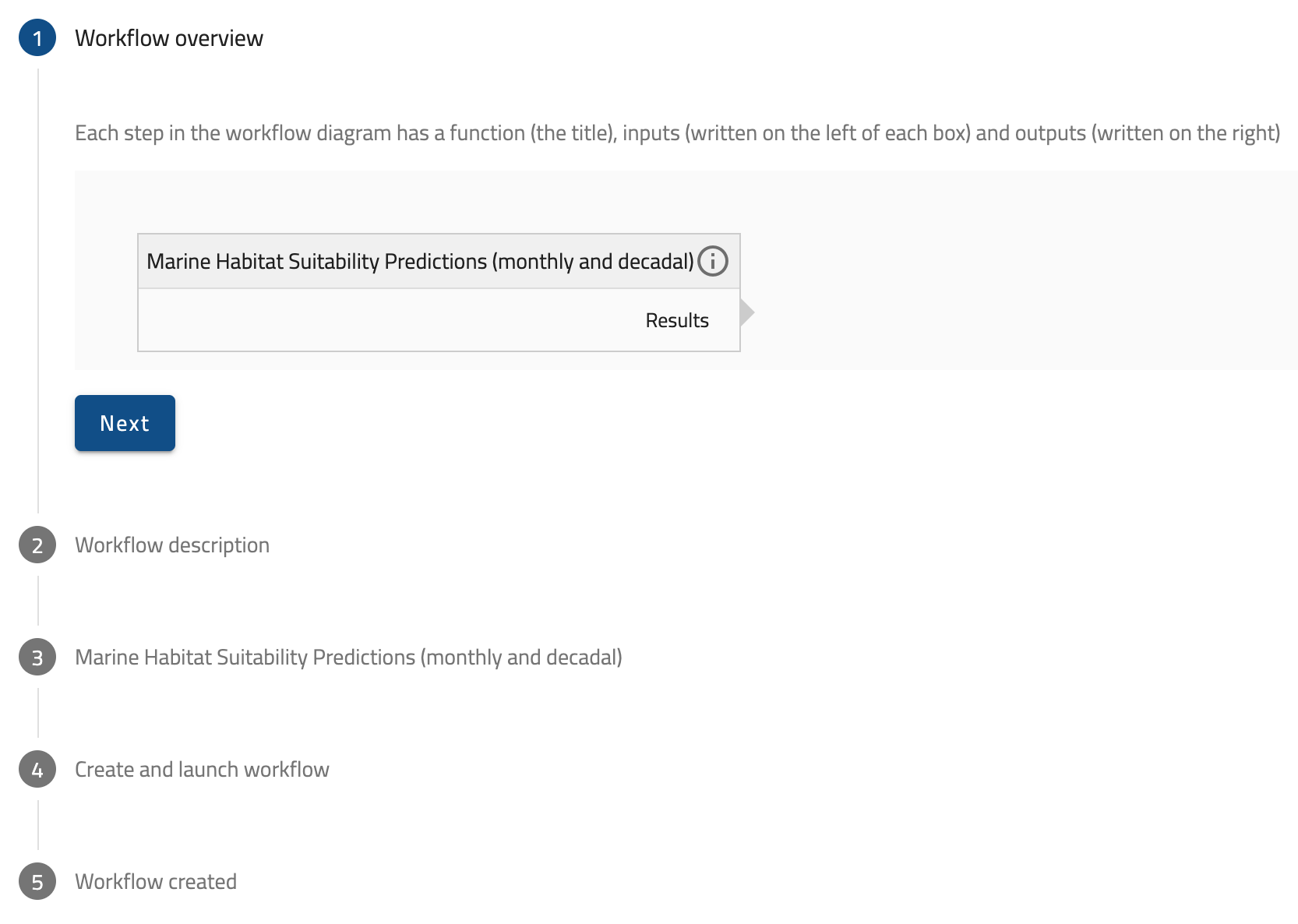
Marine Habitat Suitability Predictions (monthly and decadal)
Background<div>The European Union's Habitats and Birds Directives (Council directive 92/43/EEC; Directive 2009/147/EC) serve as essential frameworks protecting habitats and their species. To support effective management under these directives, it is necessary to understand both the current distribution of these species and how their habitats may shift in the future under climate change scenarios.</div><div>Introduction</div><div>Habitat suitability models (HSMs) estimate the statistical relationship between observed species occurrences and environmental variables to infer relative habitat suitability across an area. Numerous modelling algorithms exist to fit presence-only data coupled with background points. An ensemble model combines these individual models, leveraging their differences, to obtain more robust predictions. This workflow applies HSMs using occurrence data from EurOBIS (EurOBIS 2025) and environmental predictors from CMEMS (Copernicus Marine Service 2025), and EMODnet (Beja et al. 2024), and predicted environmental conditions under different climate scenarios (Shared Socioeconomic Pathways, SSP, Riahi et al. 2017) from Bio-ORACLE (Tyberghein et al. 2012; Assis et al. 2024) . The workflow generates monthly and decadal habitat suitability predictions for harbour porpoise, harbour seal, common bottlenose dolphin, and common dolphin in European waters (OSPAR regions II-IV).</div><div>Aims</div><div>Two modelling approaches are implemented generating habitat suitability predictions with two temporal scopes:
1. Monthly predictions to characterise seasonal dynamics;
2. Decadal models to assess long-term trends under SSP climate scenarios (2020-2100). Overall, the workflow: i) compiles and cleans occurrence data; ii) couples species occurrence data and background points with environmental variables; iii) fits ensemble models for present and future conditions; and iv) provides downloadable NetCDF maps of relative habitat suitability for each species and temporal scope.
3. These outputs aim to support evidence-based decision-making for biodiversity protection. Predictions represent relative habitat suitability, not confirmed presence or abundance, and should be interpreted with caution, considering species ecology, data availability and model uncertainty.</div>
Default
- Date ( Publication)
- 2025-11-23
- Status
- Completed
- Version
-
1.0.0
- Keywords
-
marco-bolo
- Keywords
-
habitat suitability model
- Keywords
-
Habitats and Birds Directives
- Keywords
-
climate change
- Keywords
-
species occurrence
- Keywords
-
environmental variables
- Keywords
-
Copernicus
- Keywords
-
EurOBIS
- Keywords
-
EMODnet
- Keywords
-
Bio-ORACLE
- Keywords
-
habitat suitability prediction
- Keywords
-
harbour porpoise
- Keywords
-
harbour sea
- Keywords
-
common bottlenose dolphin
- Keywords
-
common dolphin
- Access constraints
- License
- Use limitation
-
<a href=" https://spdx.org/licenses/AGPL-3.0-or-later" target="_blank"> https://spdx.org/licenses/AGPL-3.0-or-later</a>
- OnLine resource
-
Link to the workflow
(
WWW:LINK-1.0-http--link
)
- Service Name
-
Marine Habitat Suitability Predictions (monthly and decadal)
- Service Description
-
Monthly and decadal habitat suitability predictions using an ensemble model approach. Habitat suitability models (HSMs) estimate the statistical relationship between observed species occurrences and environmental variables to infer relative habitat suitability across an area. Numerous modelling algorithms exist to fit presence-only data coupled with background points. An ensemble model combines these individual models, leveraging their differences, to obtain more robust predictions.This workflow applies HSMs using occurrence data from EurOBIS (EurOBIS 2025) and environmental predictors from CMEMS (Copernicus Marine Service 2025), and EMODnet (Beja et al. 2024), and predicted environmental conditions under different climate scenarios (Shared Socioeconomic Pathways, SSP, Riahi et al. 2017) from Bio-ORACLE (Tyberghein et al. 2012; Assis et al. 2024) . The workflow generates monthly and decadal habitat suitability predictions for harbour porpoise, harbour seal, common bottlenose dolphin, and common dolphin in European waters (OSPAR regions II-IV).
- Service Reference (id)
- Workflow Helpdesk
metadataMetadata
- File identifier
- d332a9d2-b982-4e01-8096-e08bae1880a1 XML
- Metadata language
- en
- Hierarchy level
- Workflow
- Metadata Schema Version
-
1.0