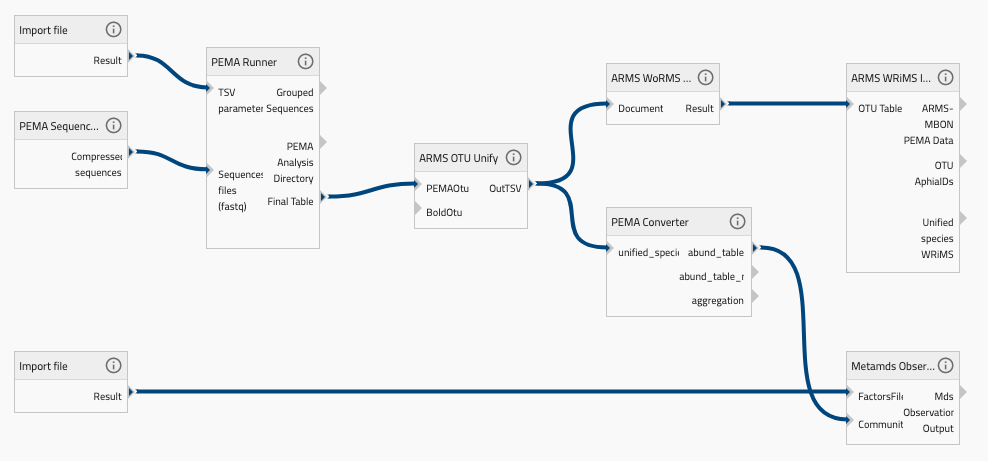
Workflow on ARMS-MBON Genomics Observatory data of hard-bottom communities - v2
Background<div>Monitoring hard-bottom marine biodiversity can be challenging as it often involves non-standardised sampling methods that limit scalability and inter-comparison across different monitoring approaches. Therefore, it is essential to implement standardised techniques when assessing the status of and changes in marine communities, in order to give the correct information to support management policy and decisions, and to ensure the most appropriate level of protection for the biodiversity in each ecosystem. Biomonitoring methods need to comply with a number of criteria including the implementation of broadly accepted standards and protocols and the collection of FAIR data (Findable, Accessible, Interoperable, and Reusable).</div><div><br></div><div>Introduction<div>Artificial substrates represent a promising tool for monitoring community assemblages of hard-bottom habitats with a standardised methodology. The European ARMS project is a long-term observatory network in which about 20 institutions distributed across 14 European countries, including Greenland and Antarctica, collaborate. The network consists of Autonomous Reef Monitoring Structures (ARMS) which are deployed in the proximity of marine stations and Long-term Ecological Research sites. ARMS units are passive monitoring systems made of stacked settlement plates that are placed on the sea floor. The three-dimensional structure of the settlement units mimics the complexity of marine substrates and attracts sessile and motile benthic organisms. After a certain period of time these structures are brought up, and visual, photographic, and genetic (DNA metabarcoding) assessments are made of the lifeforms that have colonised them. These data are used to systematically assess the status of, and changes in, the hard-bottom communities of near-coast ecosystems.</div><div><br></div><div>Aims</div><div>ARMS data are quality controlled and open access, and they are permanently stored (Marine Data Archive) along with their metadata (IMIS, catalogue of VLIZ) ensuring data fairness. Data from ARMS observatories provide a promising early-warning system for marine biological invasions by: i) identifying newly arrived Non-Indigenous Species (NIS) at each ARMS site; ii) tracking the migration of already known NIS in European continental waters; iii) monitoring the composition of hard-bottom communities over longer periods; and iv) identifying the Essential Biodiversity Variables (EBVs) for hard-bottom fauna, including NIS.
The ARMS validation case was conceived to achieve these objectives: a data-analysis workflow was developed to process raw genetic data from ARMS; end-users can select ARMS samples from the ever-growing number available in collection; and raw DNA sequences are analysed using a bioinformatic pipeline (P.E.M.A.) embedded in the workflow for taxonomic identification. In the data-analysis workflow, the correct identification of taxa in each specific location is made with reference to WoRMS and WRiMS, webservices that are used to check respectively the identity of the organisms and whether they are introduced.</div><div><br></div><div>PEMA Citation:</div><div>Zafeiropoulos, H., Viet, H.Q., Vasileiadou, K., Potirakis, A., Arvanitidis, C., Topalis, P., Pavloudi, C. and Pafilis, E., 2020. PEMA: a flexible Pipeline for Environmental DNA Metabarcoding Analysis of the 16S/18S ribosomal RNA, ITS, and COI marker genes. GigaScience, 9(3), p.giaa022. doi: 10.1093/gigascience/giaa022</div><div><br></div><div>Licenses:</div><div>PEMA: GNU GPLv3 license</div><div>BDS: Apache License 2</div><div>Trimmomatic, PANDAseq, PaPaRa, VSEARCH, CREST, Fastqc, RAxML-ng, Crop, EPA-ng: GNU GPLv3</div><div>Phyloseq, vegan, Swarm v2: AGPLv3</div><div>Blastn (NCBI BLAST): Public Domain Notice</div><div>Spades, RDPTools: GNU GPLv2</div><div>OBITools: cecill</div><div>Mafft: BSD license</div><div>Cutadapt: MIT License</div><div>
NOTE: this is the version 2 of the original workflow available at: <a href=" https://metadatacatalogue.lifewatch.eu/srv/eng/catalog.search#/metadata/c0dbc68f-cb78-4f07-9cac-95660e718fa2" target="_blank"> https://metadatacatalogue.lifewatch.eu/srv/eng/catalog.search#/metadata/c0dbc68f-cb78-4f07-9cac-95660e718fa2</a>.</div></div>
Default
- Date ( Publication)
- 2023-03-18
- Status
- Completed
- Keywords
-
ARMS
- Keywords
-
IJI
- Access constraints
- License
- Use limitation
-
GPLv3
- OnLine resource
-
Info page
(
WWW:LINK-1.0-http--link
)
- OnLine resource
-
Run the workflow
(
WWW:LINK-1.0-http--link
)
- Service Name
-
PEMA Sequences Retriever
- Service Description
-
This service aims to download the sequences files (fasq files) in order to run PEMA.
- Service Reference (id)
- Service Name
-
PEMA Runner
- Service Description
-
This service aims at running PEMA on all the sequences from the samples selected in Step 4. It represents the Step 5.2
- Service Reference (id)
- Service Name
-
ARMS OTU Unify
- Service Description
-
This service aims at creating an OTU table with species information that can be processed by WoRMS and WRIMS.
- Service Reference (id)
- Service Name
-
ARMS WoRMS Taxonomic Checker
- Service Description
-
This service takes the OTU tables from the previous step (running the omics pipeline) and check it using the WoRMS taxon match webservice.
- Service Reference (id)
- Service Name
-
ARMS WRIMS Invasive Checker
- Service Description
-
This service takes the output from the previous step and uses the WRIMS taxon match webservice to check the known distribution of the species.
- Service Reference (id)
- Service Name
-
PEMA Converter
- Service Description
-
This service aims to reformat and produce final output in various formats for human and machine2machine reading.
- Service Reference (id)
- Service Name
-
Metamds Observations
- Service Description
-
This service aims at running the conventional analysis for the ARMS workflow.
- Service Reference (id)
- Workflow Helpdesk
- Workflow Training
-
https://training.lifewatch.eu/resources/?resource=/course/view.php?id=38
metadataMetadata
- File identifier
- edf6017e-dc2f-4eec-8248-5a6c5de381b6 XML
- Metadata language
- en
- Hierarchy level
- Workflow
- Metadata Schema Version
-
1.0